wadoryu
Winter Course Chelmsford.

Report.
On the first weekend of February 2017 the Chelmsford Dojo again hosted the Shikukai Karate-Do International Winter Course with chief instructor F. Sugasawa Sensei.
This year the venue for the two days training was the Danbury Sports and Leisure Centre, which has an excellent training area large enough to cope with the expected numbers. This event seems to attract more and more students every year, and although it is an open Wado course the majority of the students who attended were Shikukai members.
We were honoured to host students from all over the UK and abroad. This year we had Dan grades attending from the Netherlands, Hungary and France. Being so close and well connected to Stansted Airport made it very easy for connections and transport. In addition, all of our visitors were able to sample the delights of Chelmsford, particularly the restaurants, bars and nightlife.
Sugasawa Sensei directed the training and introduced concepts which were new to many students. As always Sensei established a theme and then built upon it, helping the students to make practical connections across kata and kumite. Saturday training included kata at all levels, taught by Shikukai senior instructors with Sugasawa Sensei on hand to clarify specific points and add new dimensions. Sunday’s training involved kumite, across Kihon Gumite, Kumite Gata and other pairs work.
A Dan grading took place on the Sunday. Successful candidates were, Roberto Ciuffa from Shikukai Hertford for 1st Dan and Attila Jakab Shikukai Hungary for 3rd Dan.
Everything ran incredibly smoothly; airport runs coordinated efficiently and for those staying over, accommodation suited everyone’s needs. All of this was down to a very efficient team; a huge thank you to all involved.
We are already making plans for the Shikukai Winter Course for the first weekend in February 2018.
Tim Shaw
Composure.
I am sure he won’t mind me saying this but Shikukai chief instructor Sugasawa Sensei always impresses me with his appetite for embracing words and concepts that exist in the English language. He is always searching for the most apt linguistic model to try and cross cultural and language barriers. Once he latches on to a new word, analogy or aphorism he exploits it with great energy.
One such word cropped up a little while ago.
On an instructors course Sensei used the word ‘composure’; I won’t go into detail about the context in which Sensei used this word; but it had me thinking more about what it means for us and how it is applied.
‘Having an air of composure’, i.e. what the attributes of composure communicate to others. This is without a doubt a useful and positive persona to project, especially for martial artists. But it has to be real; it should not be faked or put on and taken off like your Keikogi jacket.
Projecting composure should be a natural by-product of a balanced mind; something we should all aspire towards; easy to talk about but difficult to achieve. This doesn’t mean that we shouldn’t aim to become more balanced and more composed, but identifying the times when we are cool and composed; (or the reverse, flustered, angry or allowing situations or people to overcome you), are good places to start.
In Oriental philosophy Neo-Confucianists like the Japanese scholar Kaibara Ekken (1630-1714) encouraged self-examination, monitoring your behaviour and ‘renewing yourself each day’. He also said that you should listen to trusted and reliable friends and allow them to point out your errors. Expanding on this he says it is like the game of Go where the outsider/onlooker can often see the right move before the players can.
Returning to the ‘air of composure’. Your mental attitude projects outwards and is easily picked up by others. As humans we are very good at this and are sensitive to even the most subtle forms of non-verbal communication; look how we ‘mirror’ other people’s gestures subconsciously, to let them know that we are on their wavelength. A steady gaze, relaxed and alert posture, confident, (but crucially, non-aggressive) give clues and act as hints and messages to others. The reverse is also true: shifty downcast eyes, tensed shoulders are all negative messages; as are aggressive looks, pushed out chest, agitated behaviour, all red flags to others in the vicinity.
New Age philosopher and guru Eckhart Tolle in his description of what he calls the ‘pain body’ describes the burdens people carry around with them, of past anger, anxiety and pain; on to which they willfully heap new anxieties, pain, anger, creating a destructive cocktail which often has further unhappy endings.
But he also says that negative angry people act as a magnet to other negative angry people. They spot each other across a crowded floor and are drawn to each other like preening cockatoos who attack their own reflections in a mirror.
Or another example is how angry negative people are pulled into relationships with other angry negative people; their life dramas mirror each other and their destructive flashpoints cause chaos which affects all around them, but is particularly damaging for themselves. Wrapped up in their own back-story they can’t see the wood for the trees.
Composed people are a much more attractive option. They are the people you can rely upon in a crisis, they are cool, unflappable and confident; but, hopefully, they are not just a machine, they also have a beating heart. Something every martial artist should aspire to.
Tim Shaw
Apocrypha.
“Apocrypha: A story or statement of doubtful authenticity, although widely circulated as being true.”
The truth is that the martial arts abound with Apocrypha, but I don’t think that this is a bad thing, as long as they are all taken with a huge pinch of salt.
My approach to some of the apocryphal stories about the martial arts is that I look for the kernel of truth within the myth. Not from the view that there must be tiny element of veracity lurking underneath the embellishments of stories told and re-told hundreds of times; but instead I look for the lesson or moral behind the survival of such a story – it could perhaps contain a greater truth than the fairy-tale pretends to.
Here are two of my favourites that serve to explain my thinking.
Someone told me a story about tourists being shown around a famous Chinese Temple associated with martial arts. On arriving at a particular courtyard the guide pointed out regular hollows worn into the brick paving. The tourists were told that these hollows were the result of martial arts monks spending hour upon hour in horse stance practicing their moves. However, the observant tourist might also notice that the hollows may also have been the result of weak spots in overhead roof drainage where rainwater had dripped over hundreds of years. Naturally the guide chose to ignore this very practical explanation; thus the myth lives on. Should we therefore scoff at this deliberate hokum? I don’t think so. The factual account might be wrong but the essence of the story contains another truth; more like a model, an idea, a concept. It conjures up a heightened and exaggerated admonishment endorsing the fruits of disciplined and prolonged practice, and, to my mind that makes it useful.
Another example concerns a story about one of members of the Yang family of late 19th century Tai Chi fame. It was said that if a bird was to land on master Yang’s outstretched index finger, the bird would find itself unable to fly away unless the master permitted it to do so. The explanation for this was that the master was so highly tuned to pressure sensitivity that when the bird tried to use its legs to launch the master would detect this and very subtly deny the bird a platform necessary to spring forth. Is this actually possible? Would a specialist in avian anatomy and the physiology of flight be able to tell us that this story is complete bunkum, because a small bird does not actually need to launch with its feet? I don’t know, and frankly I don’t care. The concept of heightened sensitivity is vital to practitioners of all martial arts (or at least should be) therefore to cook up such a seemingly tall tale serves as an aspirational template; albeit an apparently impossible one.
There are other stories where the essence surpasses the truth. There is something about the martial arts that promotes the telling of tall tales. Obviously some of these are there for political reasons; the mythologies live on long after people have passed away. I have seen recent examples where a certain level of gloss has been applied to boost the reputations of the living and the dead. Tales retold have an inevitable life of their own.
Tim Shaw
‘Never give a sword to a man who can’t dance’.
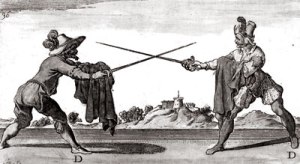
I’ve known this quote in various forms over the years, including ‘A man that can’t dance has no business fighting’.
Nobody seems to know exactly where this comes from; some say Confucius, others say it’s an old Celtic proverb. And even more disagreements occur over what it actually means. Some equate dancing with community, fraternity, even love and happiness, to counterbalance against the cult of the sword and the necessity for violence. I believe that you can make of it what you want.
I originally took it mean the skills needed to be a successful dancer have a similarity to the skills needed to be a successful fighter. Coordination being paramount; but also reading the rhythm and tempo of what you are reacting to. Taking the bigger picture it could be said that you read and react to elements of the physical world outside of yourself; so you perceive and measure the mood and intention of external forces and respond in a balanced way.
But it is interesting to stretch this comparison with the dancer even further. Take it from the point of a pair of dancers, imagine ballroom or passionate Tango. At first glance the connection between the pair is about cooperation, they work in a collaborative manner; they mesh perfectly and display their grace and fluidity effortlessly. Making a comparison with fighters this seems like a complete contradiction; two people who engage in combat don’t act like dancers, they try their utmost to baffle and confuse the opponent, they try to ‘wrong foot’ their attacker and fighters try hard to not get caught ‘flat footed’.
But perhaps that’s a little too narrow.
For example; there is rhythm in fighting. In free engagement you can dictate a rhythm for your opponent to unconsciously follow, draw him in, lull him into an expected pattern and then…break it. An opponent can be led by a shift in angle or stance or deceived by a posture or attitude. In Wado this can be done in free fighting and features in the more subtle elements of some of the paired kumite. In some of the more overt Jujutsu based paired kata Uke is forced into a response that is drawn out of him by Tori who leads him towards his own destruction. So there is an interplay going on. The usually accepted understanding of Uke as one ‘who receives’ is far too simplistic. Uke is not the stooge, fall guy or goon of Tori, there is two-way traffic going on here; this is an interplay of forces and intentions.
It’s a big subject, but…
Just to throw more mischief into the discussion, here is a quotation to leave you pondering. Nietzsche said, “I say unto you: one must still have chaos in oneself to be able to give birth to a dancing star”.
Shimmy or sashay around that one!
Tim Shaw
Be wary of simple answers to complex questions.
With the internet there are so many ways to put your opinions out to the world and the problem is that when people are given the platform to state their views they will seldom have the courage to change those views should some new piece of knowledge come to light that challenges them.
If you do find that something you’ve stated as a fact turns out to be untrue, what do you do? Stubbornly hold on to your theory clinging on desperately to any piece of scant evidence that will support that view? Or do you crawl into a hole never to venture out into the world of opinions again? Or, do you re-evaluate, take stock, admit you were wrong and re-calibrate your views? I hope that all of us are big enough to do the latter. A quote attributed to Mohammed Ali is that “If a man looks at the world when he is 50 the same way he looked at it when he was 20 and it hasn’t changed, then be has wasted 30 years of his life” .
So it is with views about martial arts. I would say that people often carry on doing the martial arts for different reasons than the ones they started. For some people it starts with lack of confidence or even fear, for others it’s the buzz you get from the physical exercise. But carry on long enough and these issues either disappear altogether or are pushed to the back of the list. Opinions change, ideas change, your attitude changes, lifestyles and life choices change and your body changes. If your martial arts training is grown up enough and has scope and depth there will be room for changes of opinion or even changes in lifestyle.
If your martial system has the hallmark of a certain maturity to it then lives and opinions can flex comfortably within the framework of the system. The irony is that viewed from the outside Japanese Budo may look rigid and locked in its bubble, but this should not be the case. Budo should help to make better people and it is my view that it can act as a lens to help you address some of the bigger existential issues in life.
But understanding what goes on inside the world of Budo is not easy, even though we tend to reach for easy descriptions. Human lives are just as complex if we live in Western Europe or the Far East.
To bring it closer to home; when we try to get a handle on what Ohtsuka Sensei was thinking when he devised the Wado Ryu, we have to place our thinking in a Japanese context. Things don’t happen in a vacuum; creations such as Wado Ryu are influenced by all manner of cultural forces. When Ohtsuka Sensei first presented his creation it wasn’t to the world, it was to the Japanese Budo establishment, the world had to come later. This creation did not spring fully formed; it was refined over subsequent decades, even today there are people who cannot comprehend this idea of refinement over time and want to preserve Wado in a time capsule. If the Art world had allowed such a thing to happen artists would be scrawling on cave walls!
Like Art Wado moved on and still continues to move. But I think that where Wado has an advantage over other martial arts who may be struggling to move forward or even survive, is that its key principles are simple. In Wado there are no flowery extras, no pseudo mystical obfuscations, the rules are easy to understand – it’s the ‘doing them’ bit that is difficult.
Tim Shaw
“If all you have is a hammer, everything looks like a nail”.
Both Abraham Maslow and Abraham Kaplan are credited with the phrase “If all you have is a hammer, everything looks like a nail”. I have seen this phrase used as a great leveller in discussions relating to martial arts training, particularly when someone’s entrenched ideas need a good shake up.
In 1964 Kaplan called it ‘The Law of Instrument’ and it is used to describe the tendency towards very narrow explanations. Although it has negative connections it can be a useful litmus test for our own ideas and assumptions.
I remember getting into a discussion about punching in Wado and trying to suggest that there was more going on than just the idea of developing punching power. The person I was discussing this with was very much of the opinion that power punching was the only reason we operate Junzuki and Gyakuzuki the way we do. I have to admit that in my early years of training that was the way I thought too. Any kind of strike had to have as its one single goal destructive power. Later on I was to meet people from other styles who also used blocks as strikes – I liked the idea and started to use forearm conditioning training, until I smartened up and realised that I was just inflicting damage on myself for short term gain.
For me it took an embarrassingly long time to shake these ideas off. ‘More speed more power’ didn’t cut it any more. The idea of turning myself into the human version of an Intercontinental Ballistic Missile was all beginning to look like a juvenile fantasy. But it is an argument that is bolstered by the view that the destruction of our ‘enemy’ using only our fists and feet is our sole objective – that is, the ‘hammer’ approach.
But our Wado toolbox is a much more interesting and sophisticated place; yes I’m sure there is a hammer in there; in fact there is more than one kind of hammer in there, but there are far more subtle tools. Some tools at first glance look bewildering complex, some, annoyingly simplistic yet still do not easily reveal their usage.
But to continue the analogy; being shown the tools or even laying your hands on them for the first time does not mean that you can use them effectively. Like a good workman on the job, there is a lot of accumulated knowledge that comes into play even before the toolbox is properly opened, and practice and reflection, as well as learning from those more knowledgeable than ourselves are essential to becoming a skilled craftsman.
Tim Shaw
Old Bull and Young Bull.

For those of you who know the joke about the old bull and the young bull contemplating a neighbouring field of heifers, I won’t bore you by retelling it. For those of you who don’t know it, Google it.
But basically it’s a parable highlighting the benefits of age and experience over youthful enthusiasm.
So… how to relate that to a martial arts situation?
Look around most well established Dojos and you’ll see a range of ages and grades. But it’s not the spread of grades that interests me, it’s the age demographic.
Personally I find that as a rule the more mature person can often be the better student. Yes their flexibility and general physical condition will not be as good as the youngsters, but their life experience and knowledge of their own capabilities tends to be more grounded. Mentally they are generally able to evaluate their developing knowledge and skills in a more mature way, and as long as they are able to ‘empty their cup’, their capacity to digest the more complex ideas is greater than most people half their age. For Wado this is a great advantage. The late Reg Kear described Wado Ryu as ‘a thinking man’s karate system’, and the more you climb the tree the more there is to take on board. Not that we should get carried away with the cerebral aspect of what goes on in a Wado Dojo, because it’s no good just having it in your head, you have to be able to physically do it. The intellectual and the physical in Wado are like two wheels on an axle; one without the other would make forward motion impossible.
I remember in the long distant past a particular Sensei criticizing another Sensei’s karate as ‘old man’s karate’, I didn’t buy it then and I don’t buy it now. But I believe there is a maturity in karate practice.
A 5th Dan’s Pinan Yodan should look quite different than one performed by a 1st Dan. As long as the mature karateka has kept their training consistent and not wrecked their body through silly training methods they have the capacity to work towards the higher ground.
But what about the youngster?
Twenty year olds should train and fight like twenty year olds, not like fifty or sixty year olds. All experienced Sensei should see this and create training opportunities that are age-appropriate. I always think of my cat and what he taught me. When he was a kitten he would frantically climb the curtains. Why the curtains, there’s nothing up there, I wondered? Answer; because he’s a kitten, a fizzing ball of pent up energy looking for an outlet. I ask all the senior experienced instructors; what were you like when you were twenty?
I suspect you were like the young bull.
Tim Shaw
- ← Previous
- 1
- 2
 Shikukai Wado Ryu Karate in Essex.